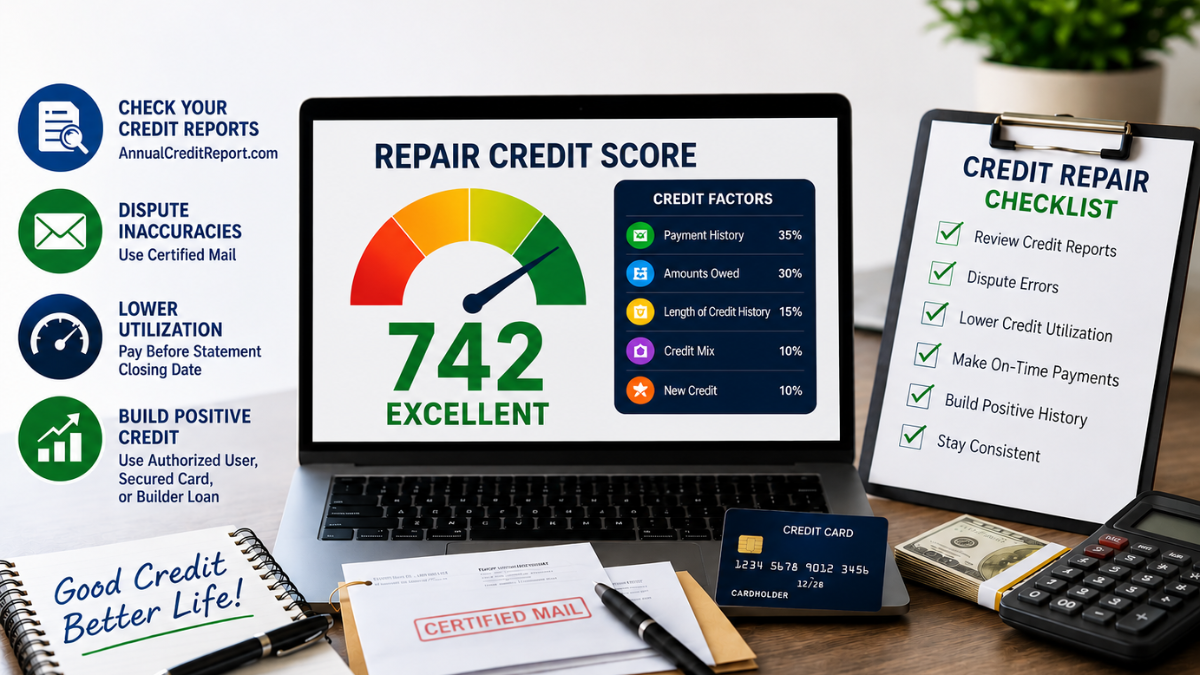
Learning whether Can You Repair Credit Yourself is one of the most practical and empowering financial steps you can take to lower borrowing costs, increase purchasing power, and regain control of your household budget. In today’s American financial system, your credit history acts as a digital reflection of your financial reliability, influencing how lenders, landlords, insurers, and even employers evaluate risk and trustworthiness.
When your history contains errors or past delinquencies, borrowing money becomes exceptionally expensive. While many commercial agencies aggressively market their services by promising quick fixes, the reality under federal consumer law is distinct: you possess the exact same legal rights and mechanical tools to audit, manage, and optimize your credit report on your own. This search-optimized guide breaks down the legal foundations, step-by-step dispute processes, and strategic account-building methods required to fix credit independently, with minimal out-of-pocket costs such as postage or document copies.
Table of Contents
The Legal Foundation of Self-Directed Credit Recovery
The short answer to whether you can manage this process independently is an absolute yes. In fact, federal legislation is explicitly designed to ensure that individual consumers can advocate for themselves directly with credit institutions.
Knowing the Landscape: Your Rights Under the CROA and FCRA
Two foundational federal statutes govern the credit restoration industry and protect your rights as a consumer:
- The Credit Repair Organizations Act (CROA): This statute heavily regulates third-party credit repair firms. Under federal law, including the CROA, it is strictly illegal for any commercial credit repair company to charge upfront fees before fully completing the promised services. The law explicitly mandates that these companies provide consumers with a written disclosure statement detailing their rights. Crucially, this disclosure emphasizes that any consumer has the legal right to review and clean up their own file independently without paying corporate fees.
- The Fair Credit Reporting Act (FCRA): This law establishes the legal framework for consumer credit reporting. The FCRA requires consumer reporting agencies and data furnishers to maintain accurate information and investigate disputed information in accordance with federal law. If you believe information on your credit report is inaccurate or incomplete, you have the statutory right to dispute it directly at no cost.
Understanding these legal baselines clarifies that third-party clinics have no unique corporate communication channels, special relationships, or legal shortcuts. Every single strategy they deploy can be managed by you.
Step 1: Secure and Audit Your Official Credit Files
The absolute first phase of a successful self-directed recovery program is obtaining a complete, unedited view of the files that underwriting systems evaluate.
Accessing the Authorized National Portal
Do not rely on commercial monitoring apps or credit card dashboards that offer simplified summaries, letter grades, or estimated scores. These commercial platforms often omit critical transaction metadata, explicit delinquency timelines, and specific account codes needed for a thorough audit.
- The Strategy: Secure your complete, line-by-line disclosures directly from Equifax, Experian, and TransUnion via AnnualCreditReport.com. This is the official, federally authorized website for obtaining free credit reports under United States law.
Common Reporting Faults to Isolate:
Review your disclosures line-by-line with a highlighter, cross-referencing them against your personal bank statements, receipt files, and payment confirmations to look for:
- Inaccurate Late Payments: Missed billing cycle indicators listed on accounts that you can prove were brought current within the 30-day reporting window.
- Duplicate Collection Accounts: The exact same medical debt, utility bill, or credit card liability sold across different third-party debt buyers and published multiple times, artificially multiplying the negative weight on your profile.
- Zombie Items: Historic defaults, public records, or severe delinquencies that continue to linger on your history past the statutory seven-year federal reporting limit.
- Mixed File Errors: Personal metadata, employment records, or severe delinquencies belonging to a stranger with a similar name, birth date, or Social Security number incorrectly mapped to your file.
Step 2: Execute Written Disputes via the Certified Mail Method
If your line-by-line audit reveals inaccurate, incomplete, or unverified information, you can initiate the formal challenge process using consumer protection laws.
The Vulnerability of Online Portals
Credit bureaus heavily promote their online dispute dashboards because automated systems can process digital inputs quickly. However, experienced consumer advocates frequently avoid online filing.
Some online dispute portals include terms and conditions that consumers should review carefully, and they may provide fewer opportunities to explain disputes or submit supporting documentation than a written dispute. A written dispute sent by certified mail can provide a clearer paper trail and greater flexibility when presenting detailed evidence.
- The Strategy: Draft a formal, physical dispute letter. Include your full legal name, current address, account numbers, and a clear description of the reporting error. State the exact adjustment needed based on verifiable facts.
- The Delivery: Print your letter, enclose copies of your supporting evidence (such as bank statements or canceled checks), and mail the package via Certified Mail with a Return Receipt Requested. This trackable shipping method provides a physical paper trail that establishes a definitive legal timestamp.
The Investigation Timeline
Once a credit bureau receives your physical dispute, they must conduct a reasonable investigation under Section 611 of the FCRA. This window generally spans 30 days, though it can legally expand to 45 days if you obtained your reports through AnnualCreditReport.com or if you submit additional supporting evidence mid-investigation. The bureau will contact the furnishing creditor to verify the data.
If the information cannot be verified during this investigation, or if it is found to be inaccurate, the credit bureau is required by law to promptly modify or delete the listing. If a minor clerical typo is identified, lenders will typically update and correct the metadata rather than erasing the entire account line.
Step 3: Direct Disputes and the Goodwill Strategy
If the credit bureau rejects your challenge and verifies the information as accurate, or if the negative mark on your history is completely legitimate, your recovery plan shifts toward direct communication with the lender.
Direct Disputes Under the FCRA
If a bureau dispute fails to fix a clear reporting mistake, you have the statutory right to submit a direct dispute to the data furnisher under applicable FCRA provisions.
- The Method: Write directly to the compliance or customer relations department of the bank, credit card issuer, or collection agency that furnished the data. Outline the error using the same factual evidence you prepared for the bureau. Lenders are bound by the same federal integrity guidelines and must conduct a reasonable investigation of your direct claim.
The Goodwill Request for Minor Delinquencies
If a 30-day late payment on your file is entirely accurate but occurred due to an isolated life disruption—such as a medical emergency, natural disaster, or a technical bank transfer error—you can deploy a Goodwill Letter.
A goodwill request is a formal, non-legal letter sent directly to a lender explaining the context surrounding the past oversight. You are asking the creditor to remove the negative indicator as a courtesy to preserve a long-standing customer relationship.
Important Real-World Limitation: Lenders are under no legal obligation to grant goodwill adjustments, and accurate records are fully permitted to remain on your reports. Success depends on corporate policy and is never guaranteed. However, it remains a low-cost option for individuals with otherwise spotless payment histories.
Step 4: Pull the “Credit Utilization Lever” for Fast Adjustments
If your score is suppressed due to high revolving balances rather than negative history marks, optimizing your credit utilization ratio is one of the fastest ways to see a positive score adjustment. Your utilization is calculated by dividing your total outstanding credit card balances by your total available credit limits.
The Statement Date vs. Due Date Mismatch
A very common mistake consumers make is assuming that paying their credit card bill in full by the monthly Due Date keeps their utilization at 0%. This is an operational misconception.
Lenders do not report your balance to the bureaus on your due date. Instead, they typically transmit your account metrics on your Statement Closing Date, which represents the final day of your monthly billing cycle and occurs roughly 21 to 25 days before your due date. If you carry a high balance on the statement closing date, that elevated balance is what prints on your bill and what gets reported to the credit bureaus for the next 30 days.
- The Strategy: Log into your digital banking portal to locate your exact “Statement Closing Date.” Pay your balance down to between 1% and 3% of your card’s total limit three to five days before the statement closes. Your score may improve on the next update cycle after the lender reports this low-risk balance to the bureaus, although results vary depending on your overall credit profile.
Step 5: Diversify and Build Your Profile Legitimately
If your credit history is limited (“thin credit file”) or your score is suppressed due to historical delinquencies, adding fresh, structured positive records is an essential component of long-term credit health.
Piggybacking via the Authorized User Approach
If you have a trusted family member who maintains an impeccable financial record, you can leverage their positive history through the authorized user framework.
- The Strategy: Have the relative add your name as an authorized user to an established credit card account that features a long history of on-time payments, a high spending limit, and an ultra-low balance.
- The Mechanic: Once the bank records the account change, that card’s established positive history may begin appearing on your credit reports, introducing instant age and low utilization to your file, provided the card issuer reports authorized user metrics to the national bureaus.
Safety Warning: You do not need to physically receive or use the plastic card to benefit from the scoring calculation. However, you must ensure the primary account owner maintains positive financial habits, as any future late payments or balance spikes on that specific account will also impact your rating negatively.
Ground-Up Account Construction
If you do not have an authorized user sponsor, you can build positive payment history independently using low-risk consumer products:
- Secured Credit Cards: These cards require a physical cash security deposit (typically $200 to $500) that serves as your active credit limit. Because the lender faces zero financial risk, approvals are highly accessible even with poor credit scores. Charge a single small recurring subscription to the card each month and pay it off completely before the statement closing date.
- Credit-Builder Loans: Offered primarily by community credit unions and online financial platforms, the structures of these loans vary by lender. In many common models, the lender deposits the loan principal into a locked savings account while you make small monthly installments, releasing the funds to you only upon full repayment. Each on-time payment is reported directly to the major bureaus, helping you construct a verified payment track while simultaneously building personal cash reserves.
Self-Directed Recovery Options Framework
To help you match your current credit challenges with the correct self-directed approach, consult this reference matrix:
| Actionable Strategy | Target Factor | General Timeline | Practical Limitations & Operational Considerations |
| AnnualCreditReport.com Audit | Identifying File Errors | 7 to 14 Days | Initial step; required to pull itemized account metadata for errors. |
| Certified Mail FCRA Dispute | Removing Data Inaccuracies | 30 to 45 Days | Strict federal timelines apply; verified accurate data will remain on the file. |
| Pre-Statement Date Payment | Credit Utilization Ratio | 30 Days | Requires available cash flow to clear card balances prior to cycle close. |
| Goodwill Request Letter | Isolated Delinquencies | 14 to 30 Days | Entirely at the lender’s discretion; corporate policy varies. |
| Secured Card / Builder Loan | Establishing Fresh History | 30 to 60 Days | Requires a physical security deposit or structured monthly savings deposits. |
Critical Pitfalls and Scams to Avoid
When managing your own credit cleanup, staying informed about common industry traps is vital to protecting your identity and finances.
- Filing Disputes Online Prior to Major Financing Windows: When you submit a dispute, the account is typically tagged with a notation indicating it is under investigation. If you are actively applying for a home mortgage, underwriters may halt your loan approval file until that dispute tag is completely resolved and closed out, which can cause delays during time-sensitive financing windows.
- Overreliance on Letter Templates: Credit bureaus process incoming consumer mail using automated scanning software. If your dispute letter matches a generic internet template word-for-word, the system may flag it as frivolous or run it through automated tracks that slow down the custom review of your file. It is always more effective to state the facts of your specific error clearly in your own words.
- The “New Identity” CPN Trap: Be exceptionally wary of operations that advise you to apply for an Employer Identification Number (EIN) or a Credit Profile Number (CPN) to create a fresh credit file. Using an alternative identification number to obtain consumer credit under false pretenses can constitute identity fraud or other forms of financial fraud and may expose consumers to serious legal consequences.
Frequently Asked Questions
Can a credit repair company guarantee a specific score increase?
No. Under the Credit Repair Organizations Act (CROA), it is illegal for any company to guarantee a specific credit score increase or promise the removal of accurate, verifiable negative data. Credit score adjustments depend entirely on your unique file parameters, the nature of the errors discovered, and your ongoing financial behavior.
Does paying off an old collection account instantly remove it from your report?
No. Bringing an old debt or collection account to a zero balance stops further point drops and prevents potential debt collection lawsuits, but it does not automatically erase the historical record of the delinquency. The entry will remain on your credit history as a “paid collection” for seven years from the original date of first delinquency, though newer scoring models give less weight to paid collections than older underwriting frameworks.
What is the difference between a hard inquiry and a soft inquiry?
A hard inquiry occurs when a financial institution reviews your credit file to evaluate an official application for new debt (such as a mortgage, personal loan, or credit card line). Hard inquiries can lower your score by a few points and remain visible on your report for two years. A soft inquiry occurs when you review your own credit file or when a bank screens your file for a pre-approved promotional offer. Soft inquiries have zero impact on your credit score.
How long can accurate negative items legally remain on a credit report?
Under the guidelines of the Fair Credit Reporting Act (FCRA), negative entries—including late payments, charge-offs, and third-party collection accounts—can legally remain on your credit history for a maximum of seven years from the original date of delinquency. The only standard exception is Chapter 7 bankruptcy, which can remain visible for up to ten years from the filing date.
What happens if a credit bureau verifies a disputed entry as accurate?
If the bureau completes its investigation and confirms the data matches the creditor’s records, the item will remain on your report. If you still believe an error exists, you have the right to submit a dispute directly to the creditor that furnished the data under applicable FCRA provisions, or you can add a 100-word consumer statement to your credit file to provide context to future lenders.
Conclusion
Answering can you repair credit yourself provides you with the clarity that true credit management is a direct reflection of personal data management and financial discipline. Federal consumer protection laws like the FCRA and CROA ensure that you are fully equipped to audit your reports, challenge unverified inaccuracies, and interface directly with financial institutions completely on your own.
While mechanical adjustments like the pre-statement closing date approach can optimize your revolving credit utilization within a single billing cycle, the foundation of a healthy score depends on long-term behavioral consistency. By automating your minimum monthly statement payments, tracking your accounts weekly through secure digital dashboards, and reviewing your comprehensive disclosures annually via AnnualCreditReport.com, you can insulate your credit profile from errors and secure a stable path toward your long-term life milestones.