Understanding what dark web monitoring is and whether you need it has become a fundamental pillar of personal cybersecurity in an era defined by continuous corporate data breaches. Every time you open an online account, share your email, or input a credit card number, that information is stored on external servers that are constantly targeted by malicious actors. When these databases are compromised, the stolen credentials frequently end up on hidden networks where identity thieves buy and sell private data.
Implementing a proactive surveillance strategy for your compromised information allows you to detect exposures early, ensuring you can secure your digital profiles before cybercriminals can exploit your identity. This guide breaks down exactly how these surveillance services operate, what they scan for, and how to determine if a tracking platform is a necessary asset for your specific risk profile.
Table of Contents
The Inner Workings: How Stolen Data Surveillance Functions
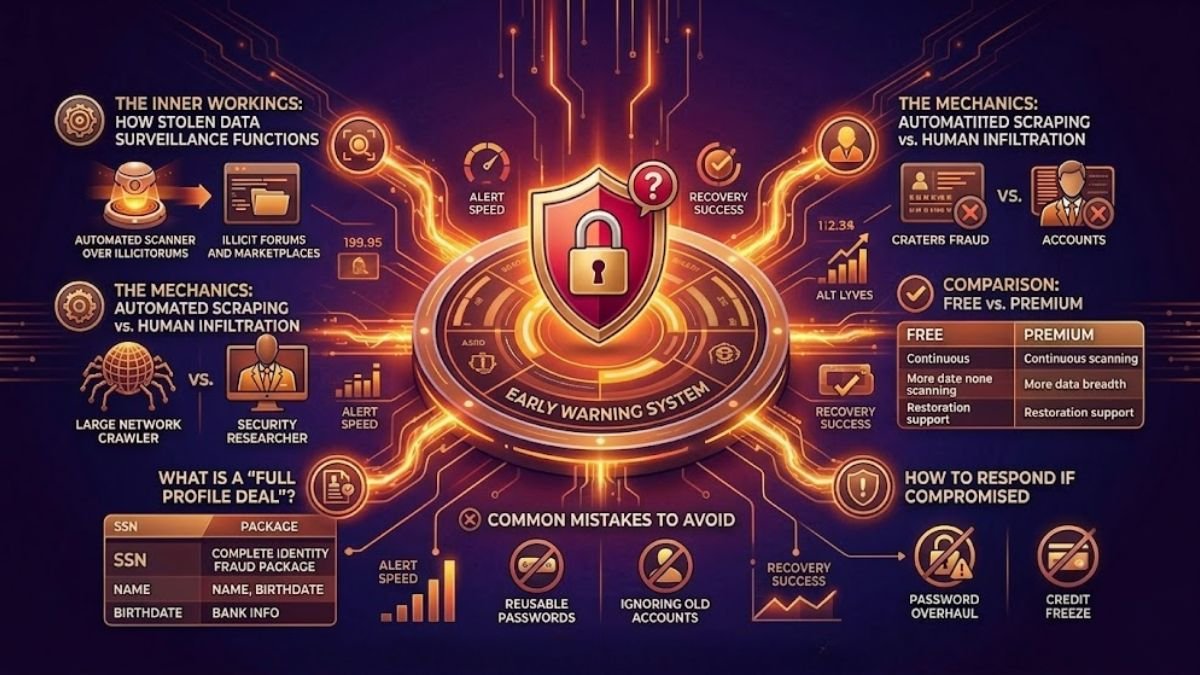
Deep web tracking platforms serve as an automated early warning system by continuously auditing hidden marketplaces, illicit forums, and encrypted chat networks where stolen personal information is traded. Instead of requiring you to navigate dangerous, unindexed areas of the internet yourself, these services use automated scrapers and human intelligence to match your specific data points against leaked databases.
- Continuous Scanning of Illicit Marketplaces: Automated crawlers systematically index data dumps on unindexed websites, black markets, and private hacker channels to locate mentions of your private details.
- Real-Time Data Matching Engines: Tracking services compare your pre-registered identifiers (such as your primary email, phone number, or Social Security Number) against trillions of leaked records instantly.
- Immediate Threat Notifications: When a positive match is detected, the platform delivers an instant alert detailing exactly which password or identifier was exposed and the source of the data breach.
- Actionable Remediation Blueprints: Along with the alert, you receive step-by-step instructions on how to contain the damage, such as freezing compromised accounts or altering exposed credentials.
- Human-Led Threat Intelligence: Specialized cybersecurity analysts infiltrate restricted, invite-only criminal forums where automated scrapers cannot gain access, checking for high-level data sales.
- Tracking Compromised Financial Accounts: The surveillance engine actively looks for leaked debit card numbers, bank routing codes, and credit profiles that are packaged for financial fraud.
- Monitoring Medical Insurance Identifiers: Surveillance includes checking for the unauthorized exposure of health insurance policy numbers, which can lead to medical identity theft and altered health records.
- Auditing Compromised Passport and Driver’s License Details: Platforms scan for leaked government identification numbers to ensure bad actors are not manufacturing physical lookalike documents using your background.
- Detecting Social Media Account Exposures: Tracking includes monitoring for leaked session tokens and login credentials for major communication and networking profiles.
- Scrutinizing Peer-to-Peer File-Sharing Networks: Scrapers audit torrent sites and unsecured cloud repositories where hackers often dump massive, unpolished corporate databases.
- Compiling Corporate Data Breach Histories: Tracking platforms maintain deep historical archives of past corporate leaks, allowing you to check if your historical information remains vulnerable.
- Tracking Stolen Phone Numbers for Communication Exploiting: Surveillance monitors for leaked cellular numbers, reducing the risk of targeted phishing text campaigns or SIM-swap attempts.
- Evaluating Exposed Security Question Answers: Tracking engines verify if common personal details used to recover passwords, like your mother’s maiden name, have been leaked online.
- Monitoring Corporate Infrastructure Vulnerabilities: For business tiers, services scan for exposed corporate email addresses, server configurations, and employee login credentials.
- Tracking Unauthorized Crypto Wallet Exposures: Advanced tracking engines monitor illicit forums for leaked private keys, public wallet addresses, and cryptocurrency exchange login details.
- Scanning for IP Address and Device Identifier Leaks: Platforms check for leaked network details that could allow bad actors to map your physical location or target your home router.
- Cross-Referencing Public Records with Hidden Leaks: Engines analyze public court documents and real estate filings to ensure leaked data isn’t being used to modify property titles.
- Tracking Leaked Workplace Credentials: Surveillance monitors whether your professional email or corporate login details have been swept up in a third-party vendor breach.
- Auditing Dark Net Dump Sites for Plain-Text Passwords: Scrapers look for decrypted, plain-text variations of your master passwords, which are highly prized by automated brute-force hacking scripts.
- Monitoring Authorized Digital Persona Profiles: Platforms check whether your full legal name and birthdate combination are being packaged together as a “package deal” for synthetic identity creation.
- Tracking Unauthorized Employment Filings: Surveillance screens for instances where your identifying numbers are being sold to individuals attempting to bypass workplace background checks.
- Scoping Encrypted Chat Network Channels: Scrapers audit underground communication applications where modern cybercriminal syndicates rapidly distribute fresh data dumps.
- Monitoring Stolen Retail Loyalty and Reward Profiles: Tracking includes watching for leaked store accounts, where thieves drain accumulated reward points or store credit.
- Evaluating Data Broker Scraping Exposures: Platforms track when public data brokers suffer internal leaks, exposing aggregated consumer dossiers to malicious actors.
- Providing Ongoing Risk Score Analysis: Based on the frequency and severity of your discovered leaks, platforms generate a dynamic vulnerability score to help you prioritize your personal security actions.
The Most Important Factors Influencing Stolen Data Surveillance
Evaluating what is dark web monitoring and do you need it requires understanding how tracking platforms operate within the broader context of personal cybersecurity and identity defense.
The Mechanics of Automated Scraping vs. Human Infiltration
- The Scale of Crawlers: Automated bots can scan millions of open criminal web pages, paste sites, and public dump repositories every hour, providing incredible breadth in data collection.
- The Role of Human Intelligence: The most dangerous data transactions occur in private, tier-three criminal networks that block automated tools; top-tier monitoring services employ security researchers who monitor restricted networks where possible to spot high-value data sales.
- The Limitations of Detection: No service can scan 100% of hidden networks due to encryption, password-protected silos, and fast-moving direct transactions, meaning surveillance should be viewed as an early warning system rather than an absolute safety guarantee.
Understanding Data Presentation: What Is a “Full Profile Deal”?
- The Assembly of Data: On underground networks, criminals rarely use a single leaked password; instead, they purchase “Full Profile Deals” (often called Fullz), which combine an individual’s real Social Security Number, name, birthdate, and banking details into a complete identity fraud package.
- Why Tracking Matters: By utilizing a service that tracks multiple indicators simultaneously, you can determine if a hacker has obtained a fragmented piece of information (like an old password) or a complete portfolio capable of causing severe credit disruption.
- Targeted Containment: Knowing exactly how much of your information has been grouped together allows you to choose the correct level of response, whether that means a simple password reset or an immediate multi-bureau credit freeze.
Common Mistakes to Avoid Regarding Hidden Network Tracking
Maximizing the value of a digital surveillance platform requires avoiding typical misconceptions that leave your peripheral accounts vulnerable to exploitation:
- Assuming a monitoring alert automatically fixes the breach: An alert is simply a diagnostic notice; you must still manually log into the compromised platform to update the password and secure the profile.
- Believing free email scanners offer complete security: Free lookup tools only provide a retrospective glimpse into historical leaks, whereas continuous paid monitoring tracks live transactions on active forums.
- Reusing passwords after receiving a data exposure alert: If a surveillance tool alerts you that a specific password was leaked, utilizing that same phrase on any other application leaves those secondary platforms exposed to credential stuffing.
- Ignoring alerts for old or unutilized online accounts: Disregarding an exposure notice for an abandoned message board or retail profile allows hackers to use that old account as a jumping-off point to guess your security questions on major financial apps.
- Assuming tracking tools can prevent a data breach: Surveillance platforms function purely as detection systems; they look for data after a corporation has already suffered a security failure, making proactive account settings like multi-factor authentication (MFA) an absolute necessity.
Comparison: Free Scanner Tools vs. Premium Continuous Surveillance
| Evaluation Metric | Free Lookup Scanners | Premium Surveillance Platforms | Recommended Use Case |
| Scanning Frequency | Manual check-ins initiated entirely by the user. | Continuous, automated real-time scanning 24/7. | Premium is essential for active professionals with multiple financial accounts. |
| Data Breadth | Limited primarily to public email leaks and plain-text passwords. | Monitors SSNs, medical IDs, passports, bank routing, and driver’s licenses. | Premium is necessary if you want to defend against deep financial and identity fraud. |
| Forum Access | Restricted to public paste sites and indexed data dumps. | May monitor private or restricted forums where possible and encrypted chat networks. | Continuous tracking provides notice of closed-door database sales before they go public. |
| Recovery Support | Provides general educational articles on how to update account settings. | Offers dedicated identity restoration specialists and $1M+ insurance frameworks. | Premium offers a critical financial and logistical safety net if identity theft occurs. |
How to Respond If a Surveillance Alert Confirms an Exposure
If your data tracking platform delivers an immediate notification confirming that your personal information has been discovered on underground networks, executing a swift containment strategy can isolate the threat.
- Execute an Immediate Password Overhaul: Log into the exposed account immediately and generate a long, unique password using an encrypted manager, ensuring the compromised phrase is completely retired.
- Activate App-Based Multi-Factor Authentication: Enable secondary verification layers on the compromised profile, preferring app-generated tokens (like Google Authenticator) over standard SMS text codes, which can be intercepted via SIM swapping.
- Audit Linked Financial Accounts: If the data breach occurred on an e-commerce platform or banking site, review your credit card statements for minor test charges and consider requesting a replacement card with a fresh account number.
- Initiate a Preventive Credit Freeze: If the alert indicates that deep identifiers like your Social Security Number or birthdate were leaked, immediately contact Equifax, Experian, and TransUnion to lock access to your bureau files.
Frequently Asked Questions (FAQ)
Can a dark web monitoring service remove my information from hidden networks?
No, it is mechanically impossible to remove data from illicit networks. Once data is dumped onto a private server or peer-to-peer criminal network, it cannot be deleted; monitoring services focus entirely on alerting you so you can change your passwords and render the stolen data useless.
Is it worth paying for continuous data tracking if I have nothing to hide?
Yes, because identity theft often targets financial assets rather than personal information alone. Even if you practice minimalist digital habits, your information exists in bank, utility, and medical databases that are constantly vulnerable to external network breaches.
How do hackers use my leaked email address if they don’t have my password?
An email address alone allows bad actors to launch highly targeted phishing campaigns, send realistic lookalike bank alerts, or cross-reference your name against public data broker sites to piece together answers to your financial security questions.
Does having my data on the dark web mean I am a victim of identity theft?
Not necessarily. It means your information has been exposed and is available for purchase. You only become a victim of active fraud if a criminal chooses to buy that data and uses it to open unauthorized lines of credit or hijack your existing bank balances.
Trust Disclaimer
Alert speeds, scraping capabilities, and security database depths vary significantly depending on the service provider and individual subscription tiers. Data tracking platforms identify exposed information but cannot prevent corporate database breaches from occurring. Always verify your personal digital defense steps with recognized regulatory bodies like the Federal Trade Commission (FTC) or the Cybersecurity and Infrastructure Security Agency (CISA).
Conclusion
Understanding what dark web monitoring is and whether you need it ultimately depends on your commitment to maintaining clean, resilient digital boundaries. While manual account reviews and free credit freezes form an excellent foundation for personal asset protection, utilizing automated data tracking provides a critical layer of real-time visibility into areas of the internet that are inaccessible to standard web browsers.
By employing a system that continuously audits hidden forums for your sensitive information, you gain the ability to react to corporate data breaches within minutes rather than months. This proactive approach transforms security from a reactive struggle into a controlled strategy, ensuring you can preserve your credit rating, defend your financial accounts, and maintain complete digital peace of mind.